

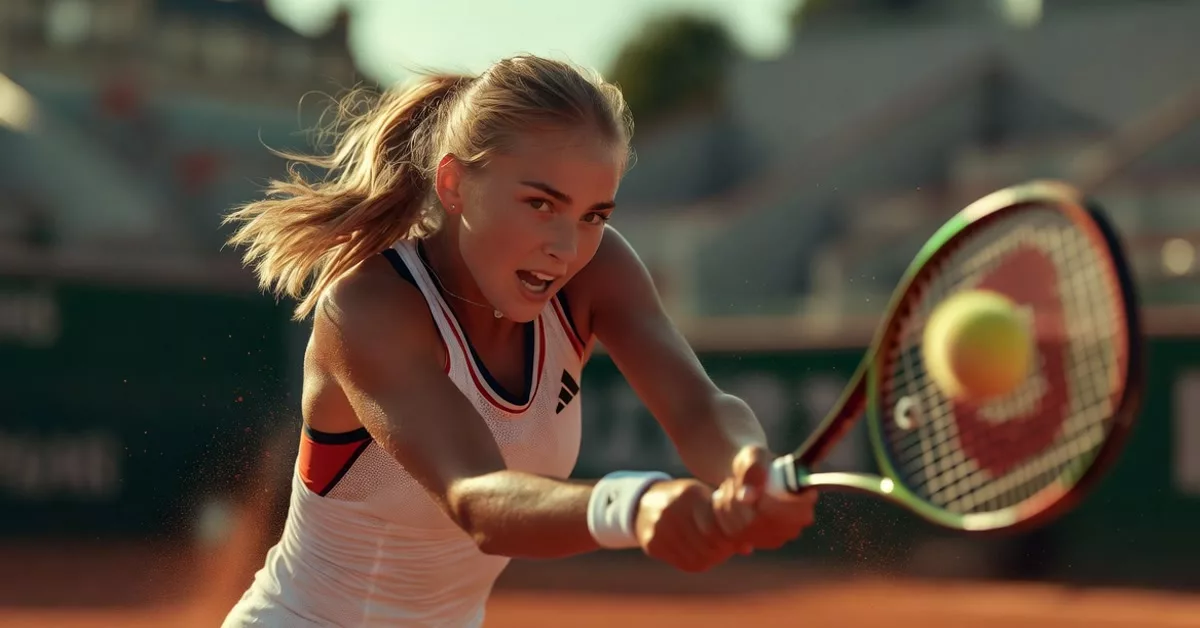
The red clay of Roland Garros is a canvas for both triumph and despair, a surface that demands not only physical prowess but also an unyielding mental fortitude. For Mirra Andreeva, the prodigious Russian talent, these very courts represent a unique crucible – a place where, just a year ago, the raw edges of her immense potential were exposed, leading to a poignant, public unraveling. Now, as she steps back onto that hallowed ground, the narrative isn’t just about a return; it’s about a profound evolution, a young woman growing up under the relentless glare of the Grand Slam spotlight, transforming the lessons of past defeats into the building blocks of future glory.
At merely 17 years old, Andreeva has already captivated the tennis world with her precocious talent, a fluid game steeped in power and precision, and an almost audacious self-belief. Yet, beneath the veneer of youthful confidence lies the inherent vulnerability of any athlete navigating the unforgiving landscape of professional sport. The moments that can “undo” a player are manifold: a sudden dip in form, an opponent catching fire, the crowd’s ebb and flow, or, perhaps most critically, the internal monologue of doubt and frustration. How Andreeva, with her exceptional gifts and nascent emotional intelligence, learns to navigate these swirling intensities will undeniably chart the course of her remarkable career. The blueprint, she assures us, is in place, even if its execution sometimes falters.
## The Crucible of Clay: A Year Ago at Roland Garros
Last year’s French Open offered a vivid, almost cinematic, illustration of Andreeva’s journey. She burst onto the scene with an electrifying run, captivating fans with her fearless approach and audacious shot-making. Her path through qualifying and into the main draw felt like a prophecy, a glimpse into the future of women’s tennis. Yet, as the stakes escalated, so too did the pressure. In a pivotal match, the cracks began to show. A missed forehand, a double fault at a crucial juncture, a perceived injustice from the umpire – each moment, individually minor, collectively chipped away at her composure.
The image of a visibly distraught Andreeva, grappling with her emotions on court, became a defining snapshot of her 2023 campaign. It wasn’t a lack of effort or skill; it was the raw, unrefined response to adversity, the understandable frustration of a teenager whose competitive fire sometimes outstripped her emotional regulation. She was, in essence, a diamond in the rough, brilliant but still needing the polish of experience. That defeat, while painful, served as an invaluable, albeit harsh, lesson. It was a stark reminder that talent alone is insufficient; the Grand Slam arena demands a holistic mastery – physical, technical, and, perhaps most profoundly, psychological. The court that ‘undid her’ wasn’t just a patch of clay; it was a mirror reflecting the nascent stages of her growth, highlighting areas ripe for development.
## Beyond the Baseline: Andreeva’s Mental Evolution
Fast forward to the present, and the transformation in Andreeva is palpable. While the fiery competitor remains, there’s a discernible shift in her on-court demeanor. The outbursts are fewer, the moments of visible frustration more fleeting. This isn’t to say she’s become a stoic automaton; rather, it suggests a burgeoning understanding of self-management, a conscious effort to channel her intense emotions into productive energy. She’s learning to compartmentalize, to let go of the last point, the last error, and focus solely on the next challenge.
This mental evolution isn’t accidental. It’s the result of dedicated work with her team, a concerted effort to develop coping mechanisms for the inevitable highs and lows of a tennis match. Techniques like strategic breathing, focusing on pre-point routines, or simply allowing herself a fleeting moment of frustration before resetting, are becoming ingrained. She’s internalizing the mantra that perfection is an illusion, and resilience is the true currency of champions. The plan she speaks of, even when it doesn’t “work the best way,” is a testament to her commitment to growth. It’s a recognition that controlling the controllables – her effort, her attitude, her tactical approach – is paramount, while external factors, like an opponent’s hot streak or a partisan crowd, must be acknowledged but not allowed to derail her focus. This maturity, far beyond her years, is perhaps her most potent weapon.
## A Prodigy’s Path: Talent Meets Tenacity
Andreeva’s innate talent is undeniable. Her groundstrokes are deep and penetrating, her movement fluid, and her court coverage exceptional. She possesses an all-court game that belies her age, capable of constructing points with finesse or unleashing raw power when required. Her serve, while still developing, shows immense promise, and her ability to read the game often puts her a step ahead of her opponents.
However, talent is merely the entry ticket to the elite echelons of professional tennis. It’s the tenacity, the willingness to refine, adapt, and push beyond perceived limits, that truly defines a champion. Andreeva has been diligently working on strengthening her physical foundation, understanding that the grueling demands of a Grand Slam require peak conditioning. Tactically, she’s becoming more astute, learning to vary her play, identify opponents’ weaknesses, and execute game plans with greater consistency. Her coaches are undoubtedly focused on her shot selection, her net play, and her defensive capabilities, all aspects that, when polished, will elevate her game to an even higher plane. The goal isn’t just to hit winners, but to build a complete, robust game that can withstand the pressure cooker of Grand Slam tennis, point after relentless point.
## The Weight of Expectation: Navigating the Tour
Being labeled a “prodigy” comes with a heavy burden. The tennis world, ever hungry for the next big star, places immense expectations on young talents like Andreeva. Every match is scrutinized, every win celebrated, and every loss dissected. This intense spotlight can be overwhelming, even for seasoned veterans, let alone a teenager still finding her footing in the adult world.
Andreeva is navigating a path trodden by countless gifted youngsters before her, some of whom flourished under the pressure, while others buckled. The key lies in maintaining perspective, staying grounded, and focusing on the process rather than the outcome. Her team plays a crucial role in shielding her from external noise, allowing her to concentrate on her development. Learning to embrace the pressure as a privilege, rather than a burden, is a critical step. She is not just playing for herself; she is playing for her potential, for the dreams that flicker in the eyes of every aspiring young athlete. Her journey is a testament to the mental fortitude required to not just survive, but thrive, in an environment where the stakes are perpetually high.
## The Road Ahead: What Defines Success for Mirra Andreeva?
As Mirra Andreeva embarks on her latest French Open campaign, the question isn’t whether she will win the title this year – though her ambition surely harbors such dreams – but rather how she will continue to evolve. Success for Andreeva, at this stage, isn’t solely measured in trophies, but in incremental gains: consistent emotional regulation, tactical intelligence under pressure, and continued physical development. It’s about demonstrating that the lessons of the past have been absorbed, that the mental plan is being executed with greater efficacy, and that the raw talent is being sculpted into a formidable, sustainable force.
Her trajectory suggests that Grand Slam titles are very much within her grasp in the coming years. But before that, she must conquer the smaller battles within each match: managing nerves, overcoming deficits, and maintaining belief when the tide turns. Each match at Roland Garros, regardless of the outcome, will be another chapter in her ongoing education. The clay courts of Paris, once a site of youthful frustration, are now poised to become a stage for her burgeoning maturity, a testament to a prodigy who is not just growing up, but growing into one of the most compelling narratives in modern tennis.
**Conclusion:**
Mirra Andreeva’s return to the French Open is more than just another tournament appearance; it’s a symbolic homecoming to a place of profound learning. The court that “undid her” a year ago now stands as a monument to her resilience and growth. Armed with renewed mental fortitude, refined skills, and an unwavering belief in her plan, she is no longer just a talented teenager; she is a rapidly maturing force, ready to write the next chapter of her extraordinary journey. The tennis world watches with bated breath, eager to witness the blossoming of a true champion, one point, one match, one French Open at a time.