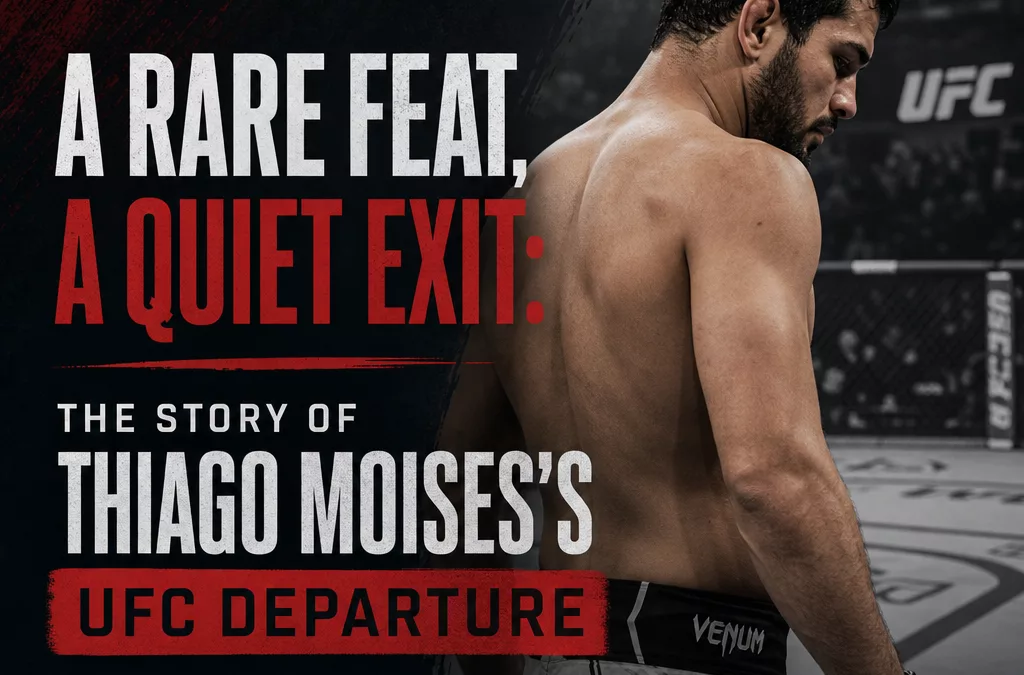
An Unceremonious End to a Gritty UFC Journey
In the unforgiving world of the Ultimate Fighting Championship, a fighter’s tenure can often end not with a bang, but with a quiet update to the digital roster. Such was the case for Thiago Moises, a 16-fight veteran of the lightweight division whose eight-year journey with the promotion came to an unceremonious end in June 2026. The Brazilian’s departure was confirmed through automated roster trackers and media reports, a stark reminder of the promotion’s relentless forward march. Moises, a fighter known for his resilience and high-level Brazilian Jiu-Jitsu, concluded his UFC run with an even 8-8 record. While a.500 record might seem unremarkable in a sport that idolizes champions, Moises leaves the organization with a unique and increasingly prestigious distinction: he is one of only two men to ever successfully take down the formidable Islam Makhachev inside the Octagon. This singular achievement, a footnote in a loss, has become a significant talking point, casting a different light on the career of a fighter who always faced the toughest challenges the division had to offer.
The Rise of a Contender Series Standout
Thiago Moises’s path to the UFC’s famed Octagon began on the proving grounds of Dana White’s Contender Series in 2018. Hailing from Indaiatuba, Brazil, and honing his craft at the renowned American Top Team, Moises arrived with a reputation as a submission specialist, a black belt in Brazilian Jiu-Jitsu whose grappling prowess was his primary weapon. He earned his contract with a spectacular first-round knockout, showcasing a striking ability that complemented his ground game. His official debut, however, was a baptism by fire against the highly-touted Beneil Dariush in November 2018, a bout he lost by unanimous decision. This initial setback was indicative of the murderer’s row of talent he would face throughout his UFC career. Moises quickly rebounded, securing a unanimous decision victory over Kurt Holobaugh at UFC 237. His early tenure was a mix of wins and losses, a pattern that would define his time in the promotion. Yet, it was a three-fight winning streak between 2020 and 2021 that truly announced his arrival as a legitimate threat in the shark tank of the 155-pound division. Victories over Michael Johnson, Bobby Green, and Alexander Hernandez, two by submission and one by decision, propelled him into the rankings and earned him the biggest fight of his career.
A Tale of Peaks and Valleys
The story of Thiago Moises in the UFC is one of inconsistency against elite competition. His 8-8 promotional record is a testament to both his skill and the sheer depth of the lightweight division. His notable victories are a who’s who of respected veterans and tough contenders. He submitted former title challenger Michael Johnson with a slick heel hook, out-grappled the durable Bobby Green, and earned a hard-fought decision over the powerful Alexander Hernandez. These wins demonstrated his potential to break into the upper echelon of the division. However, for every significant win, there was a challenging setback. Losses to future champion Islam Makhachev, the surging Benoît Saint-Denis, and crafty veterans like Damir Ismagulov highlighted the razor-thin margins at the top of the sport. His career was a constant battle against the division’s best, never shying away from a dangerous opponent. This willingness to test himself, while commendable, ultimately contributed to a record that lacked the sustained momentum needed to mount a serious title charge. He walked to the cage as the favorite in nine of his fights, winning six, but struggled as an underdog, securing victory in only two of seven such contests.
The Makhachev Anomaly: A Claim to Fame
On July 17, 2021, Thiago Moises stepped into the main event spotlight against a fighter many were avoiding: Islam Makhachev. At the time, Makhachev was a highly-ranked contender on an impressive winning streak, but not yet the champion he would become. For Moises, it was the opportunity of a lifetime. The fight itself was a grueling affair where Makhachev’s relentless pressure and suffocating grappling proved to be too much. Moises was ultimately submitted via a rear-naked choke in the fourth round, the first submission loss of his career. Yet, within that dominant performance by the Dagestani, Moises achieved something remarkable. He successfully executed a takedown on Makhachev. In a sport where statistics tell a story, this one is particularly telling. Makhachev’s takedown defense is legendary, a cornerstone of his oppressive fighting style that has seen him dominate two weight classes and claim the top spot on the pound-for-pound list. For Moises to be one of only two fighters to breach that defense speaks volumes about his own grappling acumen and timing. While it did not change the outcome of the fight, it has become his most enduring legacy in the UFC—a unique achievement against one of the most dominant grapplers in MMA history.
The Exclusive Club: Moises and Tsarukyan
To fully appreciate the significance of Moises’s achievement, one must look at the other member of this exclusive club: Arman Tsarukyan. Tsarukyan, currently a top contender in the lightweight division, accomplished the feat in his own UFC debut against Makhachev in April 2019. That fight was a back-and-forth grappling masterclass, widely regarded as one of Makhachev’s toughest early tests in the promotion. The fact that only two fighters in a combined 29 UFC fights for Makhachev (as of his last title defense) have managed to secure a takedown is an astonishing statistic. It underscores the near-impenetrable wrestling and Sambo base of the current welterweight champion. The comparison between Moises and Tsarukyan highlights the different trajectories their careers have taken since their respective encounters with Makhachev, but it forever links them in UFC trivia. Below is a look at this rare accomplishment:
| Fighter | Date of Fight vs. Makhachev | Takedowns Landed | Result |
|---|---|---|---|
| Arman Tsarukyan | April 20, 2019 | 1 | Loss (Unanimous Decision) |
| Thiago Moises | July 17, 2021 | 1 | Loss (Submission, Rd 4) |
This shared distinction serves as a permanent testament to the grappling skill of both Moises and Tsarukyan.
Analyzing the Skid: What Led to the Cut?
A unique statistic, however, cannot shield a fighter from the UFC’s performance-based reality. Moises’s release came after a difficult stretch in which he lost three of his last four fights. The downward slide began with a first-round TKO loss to Joel Álvarez, followed by a hard-fought decision win. However, back-to-back losses sealed his fate. He suffered a first-round knockout at the hands of Jared Gordon in May 2025 and, in his final appearance, dropped a split decision to Gauge Young in April 2026. Losing two consecutive fights, especially as a veteran in a division brimming with new talent, often places a fighter on thin ice. For Moises, this skid proved to be the final chapter of his UFC story. The lightweight division is arguably the most competitive in all of mixed martial arts, and the UFC continuously seeks to inject new blood into the rankings. A fighter who is not consistently winning and moving toward title contention can quickly find themselves on the outside looking in. At 31 years old, Moises is still in his athletic prime, but the promotion’s focus on building future stars and the need to make room on a crowded roster ultimately led to his departure.
The UFC’s Roster Realities: A Numbers Game
The release of a 16-fight veteran like Thiago Moises, alongside other fighters like bantamweight Cameron Smotherman and strawweight Ariane Carnelossi, highlights a fundamental aspect of the UFC’s business model. The promotion manages a massive roster of approximately 700 fighters but holds a limited number of events per year, typically around 43. This creates a bottleneck where there are more fighters than available fight slots. A primary driver for roster turnover is Dana White’s Contender Series, a summer show designed to scout and sign new talent. With the UFC expected to sign upwards of 50 new fighters from the upcoming season, space must be made. This often means that established veterans on losing streaks, even those with notable wins and unique distinctions, are released to make way for the next wave of prospects. It is a cyclical and often harsh reality of the fight game, where past accomplishments do not guarantee future security. While officials note that the door is often open for a return with impressive wins on the regional circuit, for now, Moises must ply his trade elsewhere.
What Lies Ahead for Thiago Moises?
At 31, Thiago Moises’s career is far from over. He leaves the UFC with a wealth of experience against top-tier competition and a name that carries weight in the MMA community. Rival promotions such as the Professional Fighters League (PFL), with its tournament format and million-dollar prize, could be an attractive destination. Bellator MMA and other international promotions would also likely be interested in a fighter of his caliber. Moises possesses a high-level skill set, particularly his submission game, that can pose a threat to any lightweight outside of the UFC’s top 15. The key for Moises will be to regain the consistency that eluded him in the latter half of his UFC tenure. A few decisive wins on the regional or international scene could rebuild his momentum and perhaps even open the door for a second stint in the UFC, a path many fighters have successfully navigated. For now, the MMA world will watch to see where the man who took down Makhachev lands next, and whether he can write a new, successful chapter in his fighting career.