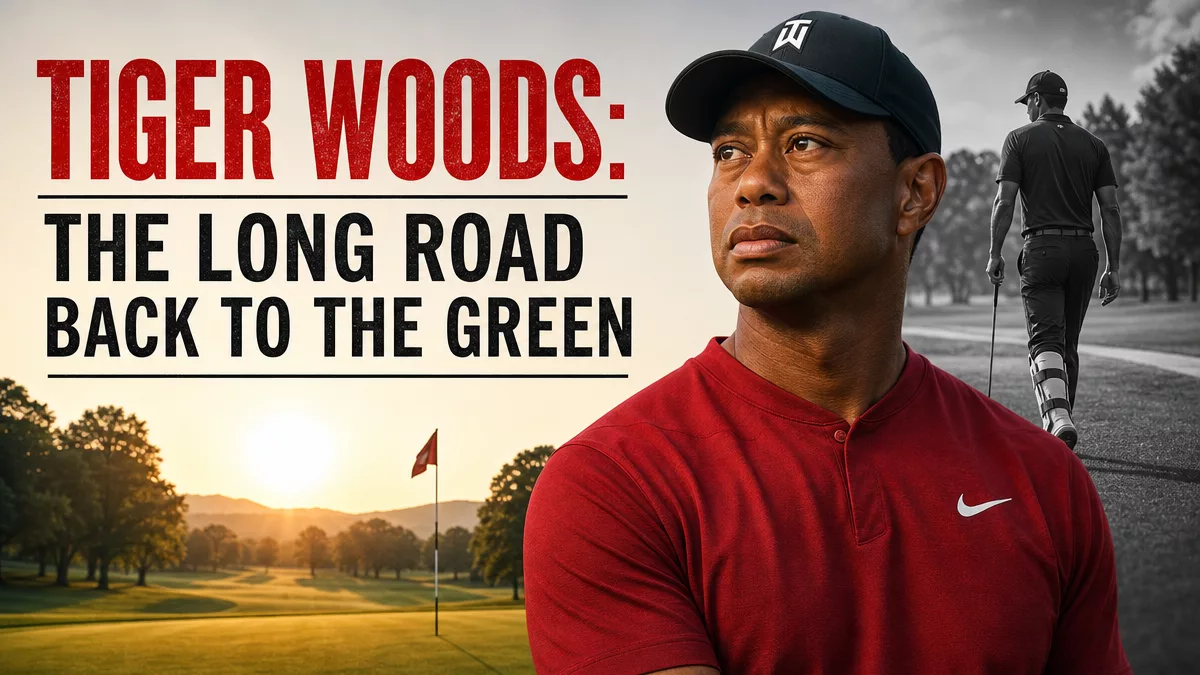
A Somber Return to the Spotlight
In his first press conference since a near-fatal rollover crash, a visibly subdued Tiger Woods addressed the world, his future in professional golf hanging precariously in the balance. The conference, held in conjunction with the Hero World Challenge, a tournament that benefits his foundation, marked a significant moment in the storied career of the golf legend. It was a stark departure from the usual confident and commanding presence the world has come to expect from the 15-time major champion. Instead, what viewers saw was a man grappling with the harsh realities of a long and arduous recovery, with no clear timeline for a return to the sport he has dominated for over two decades. The February 23, 2021, single-car accident in Rancho Palos Verdes, California, left Woods with devastating injuries to his right leg, including comminuted open fractures affecting both the upper and lower portions of his tibia and fibula. The severity of the crash was such that first responders noted he was “lucky to be alive.”
The Gruesome Details of the Crash and Injuries
The accident occurred on a notoriously dangerous stretch of Hawthorne Boulevard. Woods’ vehicle rolled multiple times, and he had to be extricated by firefighters and paramedics. He was transported to Harbor-UCLA Medical Center, where he underwent extensive emergency surgery to stabilize his shattered right leg. The medical team inserted a rod into his tibia and used screws and pins to stabilize his foot and ankle. The trauma also led to a serious condition called compartment syndrome, which required surgeons to relieve pressure in his leg to prevent muscle and nerve damage, a procedure that can sometimes lead to amputation. Woods himself later revealed that amputation was a “50-50” possibility in the immediate aftermath of the crash.
A Painful and Uncertain Rehabilitation
The road to recovery has been anything but easy. Woods described spending three months in a hospital-style bed at his Florida home, a period of immobility that was both physically and mentally challenging. He spoke of the simple joy of being wheeled outside to feel the sun on his skin as a significant milestone in his recovery. The first public image of Woods post-crash came in April 2021, showing him on crutches with his leg in a cast, accompanied by his dog. While he has since progressed from a wheelchair to crutches and is now walking on his own, the lingering effects of the injuries are profound. He candidly admitted that his days as a full-time professional golfer are over, and he will have to pick and choose which tournaments he can play in the future, much like the legendary Ben Hogan did after his own near-fatal car accident. Medical experts have affirmed the difficulty of his recovery, noting that the nature of his injuries, particularly to his ankle, could permanently affect his swing mechanics.
The “Tiger Effect” on Golf and Television Ratings
Tiger Woods’ impact on the sport of golf is immeasurable, a phenomenon often referred to as the “Tiger Effect.” His presence in a tournament dramatically increases television ratings, attendance, and overall interest in the sport. Nielsen data has consistently shown that tournaments featuring Woods draw significantly higher viewership than those without him. For instance, the final round of the 2018 Tour Championship, which marked his first win in five years, saw a 206% increase in ratings compared to the previous year. His return to the Hero World Challenge in 2023, even in a non-playing capacity, resulted in a 53 percent increase in viewership for the week. Conversely, his absence is acutely felt; the first round of the 2025 Masters, which he missed due to injury, saw a 28% drop in ESPN’s viewership compared to the previous year when he played. This quantifiable impact underscores his importance not just to the PGA Tour, but to the entire golf ecosystem.
A Legendary Career by the Numbers
To fully appreciate the gravity of a potential end to Woods’ full-time career, one only needs to look at his unparalleled achievements. He is tied with Sam Snead for the most PGA Tour wins with 82 and has won 15 major championships, second only to Jack Nicklaus’s 18. He is one of only five players to have won all four modern major championships, completing the career Grand Slam at the age of 24. His dominance in the early 2000s, including holding all four major titles simultaneously in what became known as the “Tiger Slam,” is a feat that may never be replicated.
| Tournament | Wins | Years |
|---|---|---|
| The Masters | 5 | 1997, 2001, 2002, 2005, 2019 |
| PGA Championship | 4 | 1999, 2000, 2006, 2007 |
| U.S. Open | 3 | 2000, 2002, 2008 |
| The Open Championship | 3 | 2000, 2005, 2006 |
The Future of a Golfing Icon
While the press conference left many questions about his competitive future unanswered, it also offered a glimpse into the mindset of a champion confronting his own mortality and physical limitations. Woods spoke with a newfound perspective, emphasizing his gratitude for being alive and for the support of his family and the golfing community. He made it clear that while his passion for the game remains, his priorities have shifted. His focus is on his health and his children, and any return to competitive golf will be on his terms, dictated by the capabilities of his surgically repaired leg. The golfing world will undoubtedly be watching and waiting, hoping for another comeback from the man who has redefined the sport, but also understanding that his health and well-being are paramount.
Reactions from the Golf World
The news of Woods’ accident and his subsequent public appearance sent shockwaves through the golf community. Fellow players, many of whom were inspired to pursue the sport because of him, rallied in support. During the WGC-Workday Championship shortly after his crash, numerous golfers, including Rory McIlroy and Justin Thomas, wore Woods’ signature Sunday red and black in a moving tribute. At his press conference, Woods acknowledged the outpouring of support, stating how touched he was by the gesture. His peers have expressed both their concern for his well-being and their hope for his return to the game, a testament to the respect and admiration he commands. While his future on the course remains uncertain, his influence as a mentor and an icon of the sport is stronger than ever.
What Lies Ahead for Woods and the PGA Tour
The landscape of professional golf is in a state of flux, with the emergence of rival tours and ongoing discussions about the future of the sport. Woods, even in a diminished playing capacity, remains a powerful voice in these conversations. He has been a staunch supporter of the PGA Tour and has been critical of players who have defected to the LIV Golf series. His insights and leadership will be invaluable as the Tour navigates this challenging period. While he may not be competing week in and week out, his presence at major championships and select events will continue to be a major draw. The hope among fans and officials alike is that he can find a way to manage his physical condition and continue to grace the fairways, even if it is in a limited capacity. The next chapter of Tiger Woods‘ career may look very different from the last, but his impact on the game of golf is far from over.