A Presidential Handover: Trump and Infantino to Present 2026 World Cup Trophy
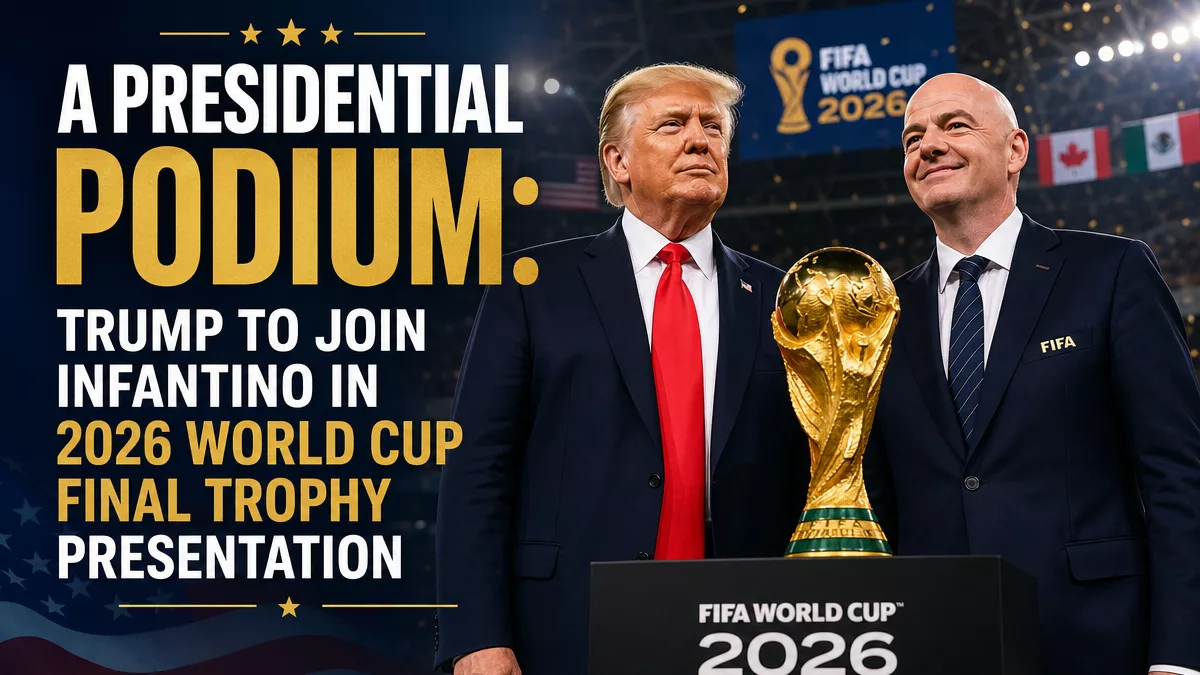
In a move that promises to blend the worlds of international sport and global politics, FIFA President Gianni Infantino has confirmed that he will be joined by United States President Donald Trump to present the trophy at the 2026 FIFA World Cup final. The declaration sets the stage for a memorable, and potentially polarizing, conclusion to the biggest single-sport event on the planet. Infantino announced on Tuesday that he and President Trump will watch the final match together before jointly handing the coveted prize to the victorious team. The final is scheduled for July 19, 2026, at the sprawling MetLife Stadium in New Jersey, a venue that will be the epicenter of the football world. This confirmation puts an end to speculation but opens the door to a host of discussions regarding protocol, precedent, and the ever-present relationship between sport and statesmanship. The decision signals a significant departure from the traditional ceremony and reflects the notably close relationship between the head of world football and the American president. As the tournament unfolds across North America, the closing ceremony is already shaping up to be as debated and analyzed as the final match itself.
The Grand Finale: A Look at the 2026 World Cup Final Stage
The choice of MetLife Stadium, which will be officially referred to as the New York New Jersey Stadium during the tournament due to FIFA’s sponsorship policies, was a major announcement in itself. The venue, located in East Rutherford, New Jersey, overcame a strong challenge from AT&T Stadium in Dallas to host the most prestigious match in football. With a seating capacity of over 82,500, the stadium is a modern coliseum well-versed in hosting large-scale events, including a Super Bowl and major international soccer matches. For the World Cup, the stadium is undergoing renovations, including the removal of 1,740 seats to widen the playing surface to meet FIFA’s stringent standards. The final on July 19 is the culmination of a 104-game tournament, the largest in history, featuring 48 nations for the first time. The event not only concludes the tournament but also serves as a capstone for the United States’ role as the primary host of the knockout stages in this tri-nation event co-hosted with Canada and Mexico.
| 2026 FIFA World Cup Final Details | |
|---|---|
| Date | Sunday, July 19, 2026 |
| Kick-off Time (Local) | 3:00 PM EDT |
| Venue | MetLife Stadium (New York New Jersey Stadium) |
| Location | East Rutherford, New Jersey, USA |
| Capacity | 82,500 |
Breaking with Tradition: A New Protocol for the World’s Most Coveted Trophy?
The involvement of a head of state in the trophy presentation is not entirely without precedent; figures like Vladimir Putin in 2018 and Qatar‘s Emir Sheikh Tamim bin Hamad Al Thani in 2022 have been present on stage. However, the plan for the 2026 final suggests a more hands-on role for President Trump, which represents a significant break from standard FIFA protocol. Traditionally, the World Cup trophy is placed on a plinth on the presentation stage. The winning team then ascends to the stage, receives their medals, and the captain collects the trophy from the stand to hoist it amidst the team’s celebrations. Reports suggest that FIFA is prepared to allow President Trump to directly hand the trophy to the winning captain, a move that places the political leader at the very center of the climactic moment. Furthermore, sources indicate that FIFA will leave it to Trump’s discretion whether he steps aside after the handover or remains on the podium with the team as they celebrate, a scenario that played out at a previous tournament. This flexibility is a departure from a choreography designed to keep the focus squarely on the victorious athletes.
A Familiar Sight: Echoes of the 2025 Club World Cup
For those who followed the 2025 FIFA Club World Cup, the scene of Donald Trump on a presentation podium will be familiar. The final of that tournament was also held at MetLife Stadium, providing a dress rehearsal of sorts for the 2026 main event. After Chelsea F.C. defeated Paris Saint-Germain, President Trump joined Gianni Infantino on stage and handed the trophy to Chelsea captain Reece James. What followed became a widely discussed moment. Trump remained on the podium, standing in the middle of the celebrating Chelsea players as they lifted the trophy. The presence of the president in the heart of the team’s private moment led to images of visible puzzlement from some players, notably Cole Palmer, whose bemused expression quickly became a viral sensation. Initially, Infantino appeared to gently guide Trump away from the center of the celebration before seemingly encouraging him to stay. This precedent from 2025 strongly suggests that a similar scene could unfold on an even grander global stage in July, and FIFA’s reported willingness to allow it underscores a deliberate shift in its ceremonial approach.
The Power Play: Inside the Infantino and Trump Alliance
The decision to feature President Trump so prominently in the closing ceremony is the latest chapter in the close and often scrutinized relationship between Gianni Infantino and Donald Trump. Described by some commentators as a “bromance,” their alliance has been visible since the United States was awarded the World Cup during Trump’s first term. Infantino has been a frequent visitor to the White House and has publicly praised the president’s support for the tournament. The FIFA president has often been seen alongside powerful world leaders, but his bond with Trump appears particularly strong. In December 2025, President Trump was awarded the inaugural FIFA Peace Prize at the World Cup Draw ceremony, an event he attended with the leaders of the co-host nations. Critics have suggested that Infantino’s cultivation of this relationship is a strategic move to ensure smooth political and logistical operations for FIFA’s most important event, while for Trump, it provides an unparalleled platform to project an image of global leadership. Their joint appearance at the final will be the ultimate symbol of this powerful and convenient partnership.
The North American Spectacle: Unpacking the Biggest World Cup Ever
The 2026 FIFA World Cup is a tournament of superlatives, making it a fitting stage for such a high-profile ceremony. It is the first time the tournament will feature an expanded field of 48 teams, up from the 32-team format that had been in place since 1998. This expansion results in a massive schedule of 104 matches played across 16 host cities in three countries. The United States will host the lion’s share of the games, with 78 matches, including all fixtures from the quarterfinals onward. Mexico will become the first nation to host or co-host the World Cup for a third time, while Canada makes its debut as a host nation for the men’s tournament. The sheer scale of the event is unprecedented, creating unique logistical challenges and immense economic opportunities. This historic tournament, coinciding with the 250th anniversary of the United States, is designed to be a continental celebration of football, and its expanded format offers more nations than ever before the chance to compete on the world’s biggest stage.
| 2026 FIFA World Cup at a Glance | |
|---|---|
| Host Nations | United States, Canada, Mexico |
| Number of Teams | 48 |
| Total Matches | 104 |
| Host Cities | 16 (11 in US, 3 in Mexico, 2 in Canada) |
| Tournament Dates | June 11, 2026 – July 19, 2026 |
A Stage for Statesmen: Who Else Will Grace the Podium?
While the spotlight will undoubtedly be on President Trump and Gianni Infantino, they are not expected to be the only political leaders present at the final ceremony. As a tournament co-hosted by three nations, diplomatic courtesy dictates the inclusion of representatives from all partners. Officials from both Canada and Mexico are also expected to be invited to attend the closing ceremony at MetLife Stadium. Canadian Prime Minister Mark Carney and Mexican President Claudia Sheinbaum, who were present alongside President Trump at the Final Draw ceremony in Washington D.C., are anticipated participants in the final’s formalities. Their exact roles in the trophy presentation have not been detailed, but their presence will be crucial to reinforcing the unified hosting concept that was central to the successful “United 2026” bid. The ceremony will therefore not only crown the world champion of football but also serve as a moment of shared political spotlight for the leaders of North America.
The Intersection of Pitch and Politics: A Controversial Ceremony in the Making
The confirmation of President Trump’s central role in the trophy ceremony guarantees that the 2026 World Cup final will ignite a firestorm of debate about the role of politics in sports. While FIFA has historically sought to present itself as a non-political entity, its actions, particularly under Infantino’s leadership, have often drawn the organization closer to political power. Allowing a political figure to be so deeply integrated into what many fans see as the sacred, defining moment of the tournament is bound to attract criticism. Proponents may argue it is a fitting honor for the leader of the primary host nation, while detractors will see it as the politicization of a purely sporting achievement. The precedent set at the 2025 Club World Cup already triggered a wave of commentary, and the global audience for the World Cup final is exponentially larger. As the final draws closer, FIFA’s decision ensures that the conversation will not just be about who wins the match, but also about who gets to share in their glory on the presentation podium.