A Nordic Return to Glory
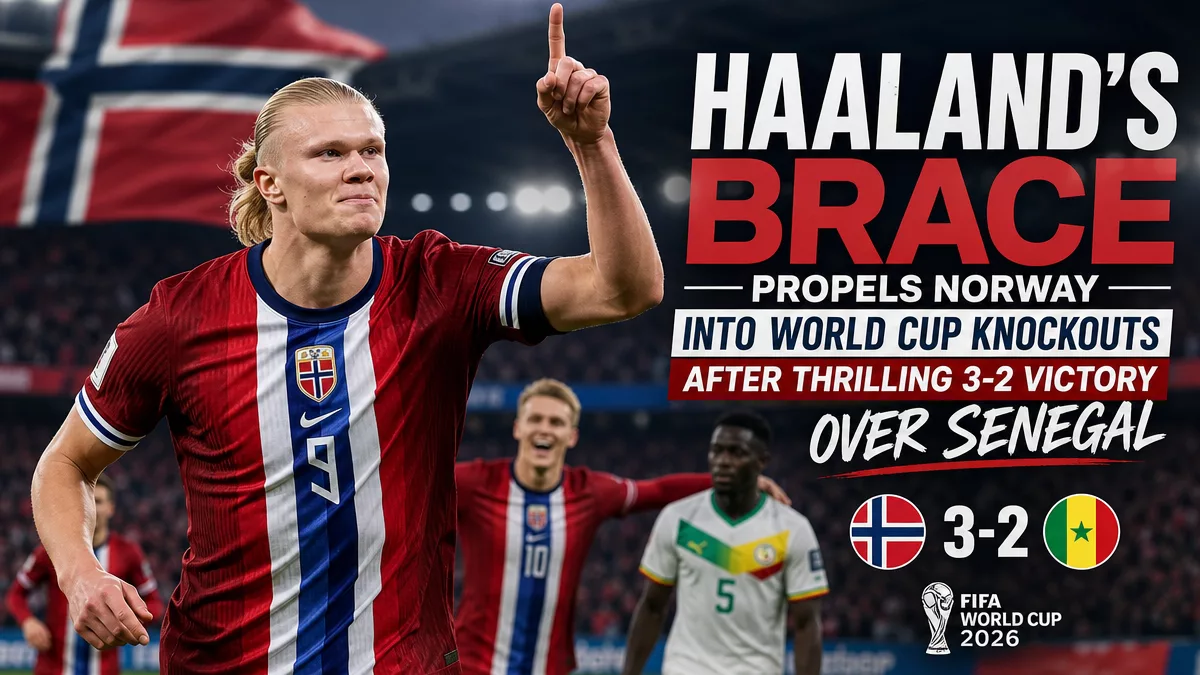
For the first time since 1998, the Norwegian flag will fly in the knockout stages of a FIFA World Cup. A generation of waiting came to a climactic end on Monday night in a nail-biting 3-2 victory over a valiant Senegal side. The hero of the hour was, predictably, Erling Haaland, whose two goals underscored a performance of raw power and clinical precision. The win, Norway’s second in as many games in Group I, guarantees their progression to the round of 32 and sets up a tantalizing clash with France to decide the group’s top spot. The atmosphere in East Rutherford was electric, with thousands of red-clad Norwegian supporters creating a sea of support, their chants echoing through the stadium as they witnessed history unfold. This victory marks a significant milestone for a nation that has been absent from soccer’s biggest stage for 28 years, a period filled with near misses and qualification heartbreaks. Now, led by a golden generation of talent, they are not just participating; they are making a statement.
Cagey Beginnings and a Supersub’s Impact
The match began as a tense tactical battle, with both teams aware of the high stakes. Senegal, having lost their opening match 3-1 to France, knew that anything less than a victory would put their tournament hopes in serious jeopardy. They started with intent, with Sadio Mané and Nicolas Jackson probing the Norwegian defense, looking for an early breakthrough. Norway, however, remained organized and disciplined under the guidance of manager Ståle Solbakken. An early blow came for the Norwegians when starting right-back Julian Ryerson was forced off with an injury just 13 minutes into the contest. Yet, this setback proved to be a blessing in disguise. His replacement, Marcus Pedersen, seized his moment in spectacular fashion. In the 43rd minute, a costly error from Senegal’s experienced captain, Kalidou Koulibaly, saw the defender misjudge a clearance. Pedersen pounced on the loose ball, driving into the penalty area and firing a firm shot that slipped past Senegal’s goalkeeper, Édouard Mendy, to give Norway a crucial lead just before the halftime whistle. It was a moment that shifted the momentum entirely, rewarding Norway’s patience and punishing Senegal’s defensive lapse.
The Haaland Show Takes Center Stage
If the first half was about disciplined team play, the second half belonged to one man: Erling Haaland. The Manchester City striker, who had already hit the post in the first half, came out after the break with ferocious intent. Just three minutes into the second period, he doubled Norway’s lead. Latching onto a perfectly weighted through ball from his captain, Martin Ødegaard, Haaland unleashed a powerful strike that rocketed into the top corner of the net, leaving Mendy with no chance. The goal was a showcase of the telepathic understanding between two of Norway’s brightest stars and a demonstration of Haaland’s devastating finishing ability. The Lions of Teranga, however, refused to be broken. They responded just five minutes later when a clever pass from Sadio Mané split the Norwegian defense, allowing Ismaïla Sarr to pull one back and reignite Senegalese hopes. But any thoughts of a comeback were swiftly extinguished by Haaland. In the 58th minute, another defensive failure from Senegal allowed Patrick Berg to set up the Norwegian talisman, who volleyed the ball in off the crossbar for his second of the night and fourth of the tournament. The celebration that followed, with Haaland cupping a hand to his ear to soak in the adulation from the roaring fans, was an iconic image of a player at the absolute peak of his powers.
Senegal’s Valiant but Vain Effort
Despite the two-goal deficit, Senegal fought until the very end. The African champions showed immense character, driven by the tireless efforts of Mané and Sarr. Their persistence paid off deep into stoppage time when Ismaïla Sarr found the net for a second time, making for a tense final few moments. However, it was too little, too late. The defeat leaves Senegal with zero points from two matches, and while not mathematically eliminated, their chances of advancing as one of the best third-placed teams are slim, requiring a massive win against Iraq in their final game and favorable results elsewhere. It’s a disappointing outcome for a team boasting significant talent, including Sadio Mané, Kalidou Koulibaly, and Édouard Mendy, who form the core of one of Africa’s strongest squads. Their performance was not without merit; they dominated possession for large parts of the game but were ultimately undone by individual errors at crucial moments.
Match Statistics and Analysis
A closer look at the numbers reveals a game that was more evenly contested than the scoreline might suggest. Senegal enjoyed the majority of possession but struggled to translate that into clear-cut chances against a well-drilled Norwegian side. Norway, in contrast, were ruthlessly efficient in attack, capitalizing on the opportunities presented to them. The statistics highlight a story of Norwegian clinical finishing versus Senegalese defensive frailty.
| Statistic | Norway | Senegal |
|---|---|---|
| Possession | 41% | 59% |
| Goal Attempts | 13 | 16 |
| Shots on Target | 6 | 4 |
| Shots off Target | 7 | 12 |
| Corners | 5 | 4 |
| Fouls | 13 | 4 |
Statistics sourced from The Guardian.
The Golden Boot Race Heats Up
Haaland’s double against Senegal propelled him firmly into the conversation for the World Cup Golden Boot. With four goals in just two matches, he is now tied for second in the scoring charts with France’s Kylian Mbappé. The Norwegian striker’s form is simply sensational; he has now scored in 12 consecutive competitive matches for his country, amassing an incredible 24 goals in that period. His performance was part of a remarkable day of action at the tournament, which also saw Lionel Messi and Mbappé score braces for their respective nations. The race to be the tournament’s top scorer is shaping up to be a battle of titans, and Haaland has thrown down the gauntlet with his prolific start. His ability to score with both feet, his physical dominance, and his unerring instinct in front of goal make him a nightmare for any defense.
Norway’s Long-Awaited Renaissance
This qualification for the knockout rounds is a landmark achievement for Norwegian football. The nation’s best previous performances were reaching the Round of 16 in 1938 and 1998. For years, Norway has watched from the sidelines as their Scandinavian neighbors have featured in major tournaments. The current squad, however, is brimming with top-tier talent playing in Europe’s elite leagues. Alongside Haaland and Martin Ødegaard, players like Alexander Sørloth and Sander Berge provide a strong supporting cast. The team’s qualification campaign was impressive, and they have carried that momentum into the finals. Their victory over Senegal was a testament to both their star power and their collective resilience, marking a potential dawn of a new era for the national team.
A Group Stage Decider Looms
With progression secured, Norway’s attention now turns to a blockbuster finale in Group I against world football heavyweights, France. Both teams sit level on six points, making their head-to-head clash on Friday a direct shootout for first place in the group. Finishing top would likely provide a more favorable path in the knockout bracket, adding immense significance to the encounter. The match will pit two of the world’s most exciting forwards against each other in Erling Haaland and Kylian Mbappé. France, with their deep well of talent and championship pedigree, will present the sternest test yet for Solbakken’s side. However, having already confirmed their place in the next round, Norway will go into the game with confidence, ready to challenge one of the tournament favorites and prove they belong among the elite.
Looking Ahead: Paths and Possibilities
The outcome of the Norway vs. France match will have significant implications for the Round of 32. The winner of Group I is slated to face a third-placed team from one of several other groups, while the runner-up will face the second-placed team from Group E. For Norway, this tournament is already a success, having ended their long absence from the knockout stages. But with a generational talent like Haaland leading the line, there is a growing belief that this team can go even further. They have demonstrated they have the firepower to trouble any opponent and the tactical discipline to manage difficult games. As they prepare to face Les Bleus, the Norwegian faithful are dreaming big, wondering just how far this exciting team can go on the world’s greatest stage.