A Day of Footballing Royalty
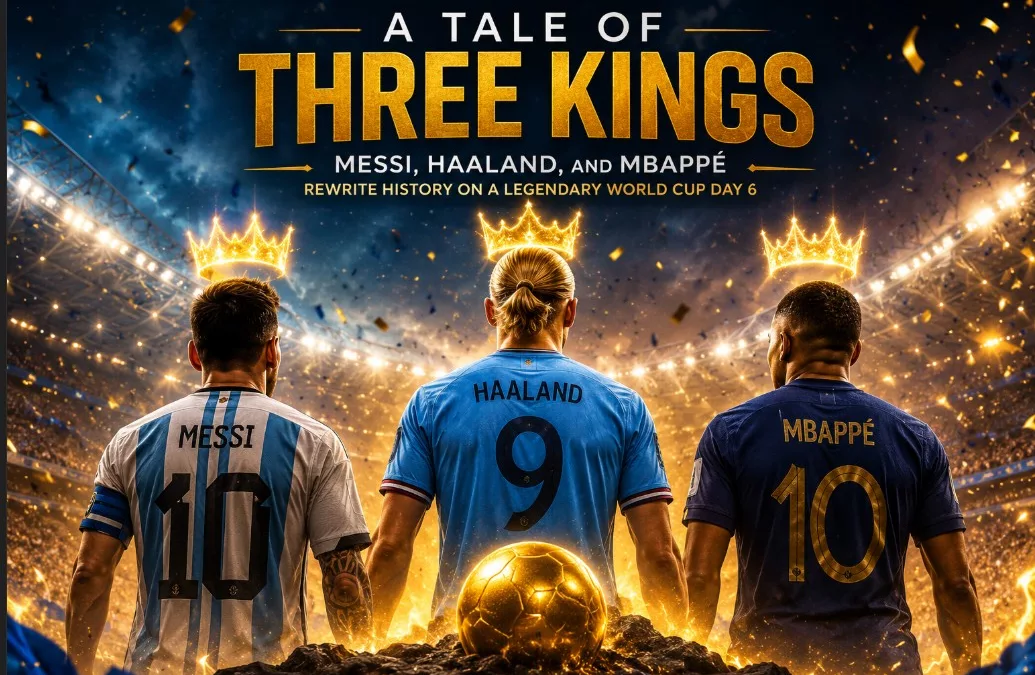
In the grand theater of the 2026 FIFA World Cup, co-hosted across North America, Day 6 will forever be etched in the annals of football history. It was a day when the torch wasn’t merely passed but blazed in the hands of three generational talents. In three separate, electrifying matches, Lionel Messi, Erling Haaland, and Kylian Mbappé delivered performances that transcended the box score, each telling a unique story of genius, power, and speed. The footballing world was left breathless, witnessing a legend cement his legacy and two young kings stake their claim to the throne. This was more than just a day of group stage matches; it was a powerful statement on the beautiful game’s vibrant present and dazzling future.
Messi’s Masterclass: Another Record Falls
In a masterclass of skill and vision, Lionel Messi guided Argentina to a commanding 3-0 victory over Algeria at a packed Kansas City Stadium. On the occasion of his 200th international cap, the iconic number 10 scored a magnificent hat-trick, a feat that saw him equal Germany‘s Miroslav Klose as the all-time leading goalscorer in men’s World Cup history with 16 goals. The first goal was classic Messi: receiving the ball deep, he ghosted past a defender and unleashed a curling shot from outside the box that nestled into the corner. His second was a poacher’s finish, reacting quickest to a rebound, while the third, completing his hat-trick, was another signature, pinpoint strike from the edge of the area. Beyond the goals, Messi was the architect of Argentina‘s every move, orchestrating the play with a level of control and creativity that defied his 38 years. He became the first male player to appear in six different World Cup tournaments, a testament to his incredible longevity and enduring class.
The Albiceleste’s Perfect Harmony
While Messi’s name rightfully dominated the headlines, Argentina’s victory was a product of a cohesive and balanced team performance. Coach Lionel Scaloni has built a unit that is not solely reliant on its talisman but is built to amplify his genius. The midfield trio of Alexis Mac Allister, Enzo Fernández, and Rodrigo De Paul provided the perfect platform, their relentless work rate and intelligent passing ensuring Argentina controlled the tempo from the outset. Mac Allister was particularly influential, his powerful strike leading directly to Messi’s second goal. The defense, marshaled by the experienced Nicolás Otamendi and the aggressive Cristian Romero, was rarely troubled, providing a solid foundation that allowed the attacking players to flourish. This synergy between the supporting cast and their legendary leader is what makes the defending champions such a formidable force in this tournament.
Haaland Unleashes the Norwegian Storm
Meanwhile, in a display of raw, untamable power, Erling Haaland announced his arrival on the world’s biggest stage with a thunderous performance for Norway. In their group stage match, the towering striker was simply unstoppable, bullying the opposition’s defense with his combination of blistering pace and brute strength. Haaland netted a spectacular hat-trick, his goals a testament to his versatile finishing ability. The first was a towering header from a corner, the second a left-footed rocket after shrugging off two defenders, and the third a composed one-on-one finish after timing his run to perfection. His relentless pressure and physical presence created chaos, opening up space for teammates like Martin Ødegaard to pull the strings in midfield. It was a performance that sent a clear message: Norway, powered by their generational talent, are not just here to participate; they are here to contend.
A Statistical Breakdown of Haaland’s Dominance
Haaland’s performance was not just visually impressive; the underlying numbers paint a picture of complete dominance. His ability to consistently generate high-quality scoring opportunities is what sets him apart. His statistics from the match, as recorded by FIFA’s official data provider, showcase a player at the peak of his powers.
| Statistic | Erling Haaland’s Match Data |
|---|---|
| Goals | 2 |
| Expected Goals (xG) | 2.1 |
| Total Shots | 8 |
| Shots on Target | 5 |
| Touches in Opposition Box | 14 |
| Aerial Duels Won | 6 |
Source: FIFA Official Match Data
These numbers highlight a player who is not just a clinical finisher but a constant threat, occupying defenders and creating chances through sheer force of will and intelligent movement.
Mbappé’s Electric Elegance for Les Bleus
Not to be outdone, Kylian Mbappé provided a dazzling display of speed and skill in France‘s 3-1 victory over Senegal at MetLife Stadium. The French captain was a blur of perpetual motion, terrorizing the Senegal defense with his explosive acceleration and mesmerizing dribbling. Mbappé scored a brilliant brace, and in doing so, became France‘s all-time leading goalscorer with 58 goals, surpassing the legendary Olivier Giroud. His first goal was a demonstration of pure pace, latching onto a through ball and calmly slotting it past the goalkeeper. His record-breaking second goal was a moment of individual brilliance, a stunning shot from outside the box that left the keeper with no chance. With these goals, Mbappé took his total World Cup tally to 14, a remarkable achievement for a player still in his prime.
The French Collective Powers Forward
Similar to Argentina, France’s success was built on a foundation of collective strength, orchestrated by coach Didier Deschamps. While Mbappé was the star, the contributions from the rest of the squad were crucial. The creativity of Michael Olise was instrumental in breaking down a stubborn Senegal defense, with his clever pass setting up Mbappé’s first goal. The late introduction of Bradley Barcola also proved decisive, as he scored a goal of his own to seal the victory. The French team demonstrated their depth and tactical flexibility, weathering an early storm from Senegal before asserting their dominance in the second half. This ability to call upon multiple difference-makers is a key reason why Les Bleus are considered one of the top contenders to lift the trophy.
A Generational Crossroads on the Grandest Stage
Day 6 of the 2026 World Cup served as a fascinating crossroads of footballing generations. We witnessed the enduring genius of Messi, a player who continues to redefine what is possible at an age when many have retired. His game is one of intelligence, precision, and an almost supernatural understanding of time and space. In stark contrast, we saw the explosive, physical dominance of Haaland, a force of nature who overwhelms opponents with power and athleticism. His style is direct, relentless, and brutally efficient. And then there is Mbappé, a player who combines blistering pace with exquisite technical skill, a modern forward who is a threat from anywhere on the pitch. His elegance and killer instinct represent the evolution of the modern attacker. The day showcased three distinct, yet equally brilliant, approaches to footballing greatness.
The Road Ahead: A Tournament Ignited
The monumental performances of Messi, Haaland, and Mbappé have thrown down the gauntlet to the rest of the 48-team field. Argentina, France, and Norway have not just secured crucial points; they have made emphatic statements of intent. For Argentina, Messi’s record-tying day has them poised to make a deep run as they seek to defend their crown. For France, Mbappé’s history-making performance has solidified their status as tournament favorites, demonstrating they have the firepower to reclaim the title they lost in 2022. And for Norway, Haaland’s explosive debut signals the arrival of a dangerous dark horse, a team capable of upsetting the established order. As the tournament progresses from the host cities across the United States, Canada, and Mexico, the echoes of Day 6 will linger, a tantalizing Analysis of the epic clashes and individual brilliance yet to come. The world is watching, captivated by a tale of three kings, each on his own quest for football’s ultimate prize.