The Modern Goal Rush: A Numbers Game?
The constant churn of the 24-hour news cycle in sports media thrives on hyperbole and the relentless pursuit of new records. In the world of international football, this is no different. We are constantly told we are witnessing unprecedented greatness, that the likes of Lionel Messi, Cristiano Ronaldo, and Kylian Mbappe are rewriting the history books with their prolific goal-scoring in the FIFA World Cup. While their talent is undeniable, a closer examination of the historical context reveals that their goal-scoring exploits, particularly in the World Cup, might not be as earth-shattering as they are often portrayed. The inflation of matches in the modern tournament format, compared to the more condensed schedules of yesteryear, provides a crucial, yet often overlooked, piece of the puzzle.
The Unassailable Peaks of a Bygone Era
To truly appreciate the context of modern goal-scoring, we must first cast our eyes back to a time when the World Cup was a different beast entirely. The name that echoes loudest through the annals of World Cup goal-scoring history is Just Fontaine. The French striker’s performance at the 1958 World Cup in Sweden is the stuff of legend. In just six matches, Fontaine found the back of the net an astonishing 13 times. This incredible feat, which included a four-goal haul against defending champions West Germany, set a record for the most goals in a single tournament that remains untouched nearly seven decades later. Fontaine’s remarkable achievement was not an anomaly in an era of supposed defensive naivety. Four years prior, in 1954, Hungary‘s Sándor Kocsis scored 11 goals, and in 1970, West Germany’s Gerd Müller bagged 10. These figures stand in stark contrast to the top scorers of recent tournaments. Kylian Mbappé won the Golden Boot at the 2022 World Cup with eight goals, while Lionel Messi scored seven. While impressive, these numbers fall significantly short of the double-digit hauls that were once a feature of the tournament.
Goals-Per-Game: The Great Equalizer
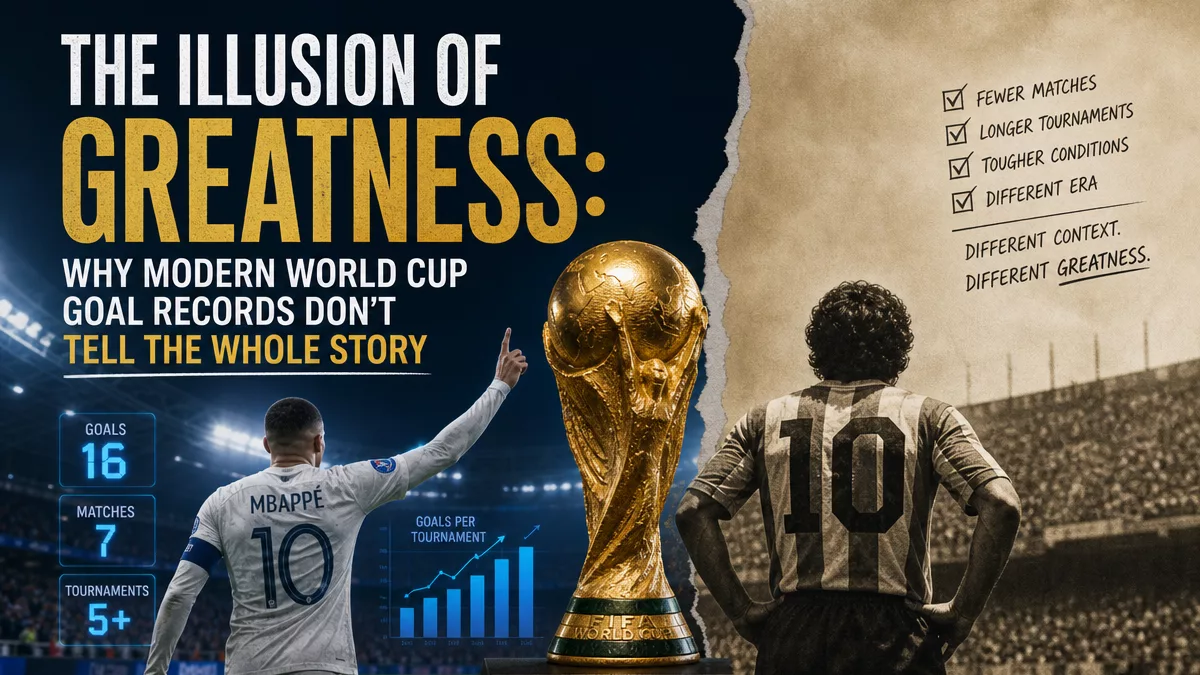
A more insightful metric for comparing goal-scorers across different eras is their goals-per-game ratio. This is where the achievements of past legends truly shine. Just Fontaine’s 13 goals in six games gives him an otherworldly average of 2.17 goals per game in the 1958 tournament. Sándor Kocsis boasts an average of 2.2 goals per game from the 1954 World Cup. When we look at the overall World Cup careers of modern superstars, the numbers, while still excellent, are more grounded. Lionel Messi, who recently became the all-time leading goal scorer in World Cup history with 18 goals, has achieved this in 28 matches over six tournaments, for a ratio of 0.64 goals per game. Cristiano Ronaldo has scored 8 goals in his World Cup appearances, yielding a more modest average. Kylian Mbappé’s record is more impressive, with 16 goals in 16 games, a one-to-one ratio that suggests he may yet challenge the records of old. However, even his impressive strike rate pales in comparison to the explosive, albeit brief, World Cup careers of players like Fontaine and Kocsis.
To provide a clearer picture, let’s examine the all-time leading goal scorers in the FIFA World Cup:
| Player | Country | Goals | Matches | Goals Per Game |
|---|---|---|---|---|
| Lionel Messi | Argentina | 18 | 28 | 0.64 |
| Miroslav Klose | Germany | 16 | 24 | 0.67 |
| Ronaldo Nazario | Brazil | 15 | 19 | 0.79 |
| Gerd Müller | Germany | 14 | 13 | 1.08 |
| Kylian Mbappé | France | 16 | 16 | 1.00 |
| Just Fontaine | France | 13 | 6 | 2.17 |
The Tournament Expansion Factor
A significant factor contributing to the inflated goal tallies of modern players is the expansion of the World Cup tournament itself. In 1958, when Just Fontaine set his incredible record, the tournament featured 16 teams. To reach the final, a team would play a maximum of six matches. The modern World Cup, and particularly the 2026 edition with its expansion to 48 teams, offers a much longer path to glory. Top teams can now expect to play up to eight matches. This increase in the number of games naturally provides more opportunities for players to score, and while it doesn’t diminish the skill required to do so, it does provide a mathematical advantage to modern forwards when it comes to accumulating raw goal totals. It is a marathon versus a sprint, and while both require immense talent, the nature of the challenge is fundamentally different.
The Longevity of the Modern Superstar
The careers of Lionel Messi and Cristiano Ronaldo have been characterized by an almost unbelievable longevity at the highest level of the sport. Messi is currently playing in his sixth World Cup, a record in itself. Ronaldo has also featured in multiple editions of the tournament. This extended period of elite performance, a testament to their professionalism and physical conditioning, has allowed them to accumulate records over a much longer timeframe than many of their predecessors. In contrast, Just Fontaine’s World Cup career consisted of that single, brilliant tournament in 1958. A career-ending injury meant he never had the chance to add to his tally. While longevity is a skill in itself, it is important to distinguish between records built over a decade and a half of consistent performance and those forged in a single, explosive burst of brilliance.
Beyond the Goals: The Impact of Pelé and Maradona
While goal-scoring is the most easily quantifiable measure of a forward’s success, it is not the only metric of greatness. The impact of players like Pelé and Diego Maradona on the World Cup cannot be measured in goals alone. Pelé, the only player in history to win three World Cups, scored 12 goals in 14 appearances across four tournaments, a remarkable record in its own right. But his influence extended far beyond his goal-scoring. He was the focal point of a Brazilian team that redefined how the game was played. Maradona’s performance at the 1986 World Cup is arguably the greatest individual tournament performance in history. He scored five goals and provided five assists, directly contributing to 10 of Argentina’s 14 goals in the tournament. His famous solo goal against England in the quarter-finals is a moment of genius that transcends statistics. These players didn’t just score goals; they defined tournaments and inspired nations.
The Case of Miroslav Klose: The Consummate Poacher
Before Lionel Messi’s recent exploits, the all-time leading goal scorer in World Cup history was Germany’s Miroslav Klose. With 16 goals in 24 matches across four tournaments, Klose was the epitome of a clinical finisher. His record is a testament to his incredible consistency and predatory instincts in the penalty area. However, Klose is rarely mentioned in the same breath as the likes of Pelé, Maradona, or even Messi and Ronaldo. This is because, while his goal-scoring record is undeniable, his overall impact on the game is not seen as being on the same level. This is not to diminish his achievement, but rather to highlight the fact that raw goal statistics do not always equate to a player’s historical significance. Klose was a phenomenal goal-scorer, but he was a component of a well-oiled German machine, rather than the singular, transformative force that players like Maradona and Pelé represented.
The Future of Goal-Scoring: Can Mbappé Break the Mold?
Of the current generation of superstars, Kylian Mbappé appears to be the most likely to challenge the goal-scoring feats of the past. With 16 goals in just 16 World Cup matches, he is scoring at a rate that is truly exceptional in the modern era. His combination of explosive pace, clinical finishing, and big-game temperament makes him a constant threat. Having already won a World Cup in 2018 and a Golden Boot in 2022, his legacy is already secure. However, whether he can maintain this incredible scoring rate over multiple tournaments and potentially challenge Fontaine’s single-tournament record remains to be seen. The tactical evolution of the game, with its emphasis on defensive organization and the increased physical demands on players, makes such a feat incredibly difficult. The very nature of modern football, with its congested calendars and the intense pressure at the highest level, may prevent any player from ever again reaching the dizzying heights of Just Fontaine in 1958.
Conclusion: A Matter of Perspective
The achievements of Lionel Messi, Cristiano Ronaldo, and Kylian Mbappé are, without question, extraordinary. They are generational talents who have pushed the boundaries of what is possible in the sport. However, when it comes to their World Cup goal-scoring records, a degree of perspective is required. The expansion of the tournament, the increased number of matches, and the remarkable longevity of modern players all contribute to a statistical landscape that is very different from that of previous eras. While the raw numbers may be impressive, they do not necessarily eclipse the achievements of past legends like Just Fontaine, whose single-tournament record remains a seemingly unbreakable monument to a different era of football. The debate over who is the greatest of all time will rage on, but it is a conversation that must be had with an understanding of the historical context that shapes the numbers. The beauty of football lies not just in the records themselves, but in the stories and the context behind them.